August 25th to 27th saw the University of Exeter host the 15th QRA International Postgraduate Symposium. This followed last years '8th' Symposium held at Manchester, demonstrating that while the gathered attendees may be the bright future of Quaternary research, basic mathematics may not be their strong suit. The discrepancy was entertainingly explained by keynote speaker Professor Chris Turney during his address, one of many highlights of the 2010 event expertly organised by Tom Roland, Becky Rixon, Charlotte Evans and Mark Grosvenor.
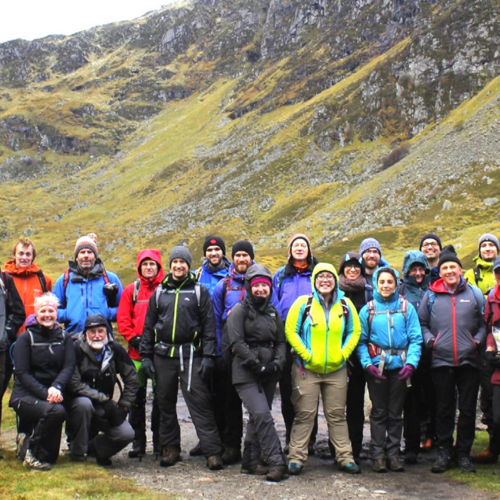
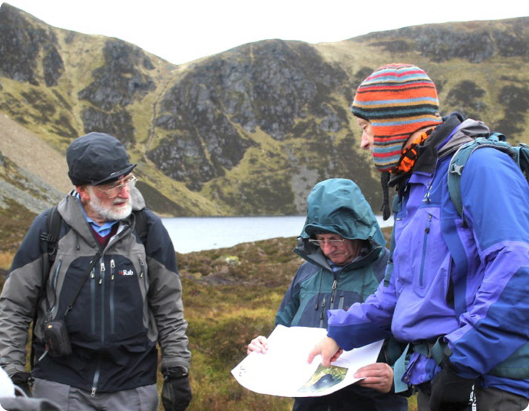
The first day, however, began under ominously dark skies, heavy with foreboding. Shortly after setting off for the first field trip site, the impressive 'Punch Bowl' in Exmoor National Park, it rained. Then it rained some more. After a period of reflection the rain decided that since it had built up such a fine pace, it really would be a shame to stop. Of course the deluge did not deter the hardy souls of the group. Dr Stephen Harrison provided a detailed description of the geomorphology and superficial deposits of the semi-oval Punch Bowl, highlighting features that he interprets as providing evidence for a cirque glacier here on Exmoor, probably during the Devensian glaciation.
The second site visited was the Valley of Rocks on the north Devon coast. The feature runs parallel with the Bristol Channel, and those willing to climb the rocky, winding path up to the summit of an impressive Lynton Slate outcrop were rewarded with views of both the cave-riddled coastline and the dry Valley of Rocks below. The valley probably represents a pre-Ipswichian route of the East Lyn River, which was abandoned when coastal erosion at Lynmouth Bay to the east captured the rivers' course. And still it rained.
Although not deterring the attendees, the bad weather did slow progress. By the time we reached the last field site of Porlock Weir, the tide had unfortunately covered the tree stumps of the submerged Mesolithic forest in Porlock Bay. The area still offered interesting features along this dynamic coastline, where a marshy lagoon has developed behind a shingle ridge. The sedimentation history of the area appears to record the influence of early upland farming communities and a rising relative sea level over the Holocene period. The group, now happily committed to a semi-aquatic existence, strolled the rain-swept shoreline examining the coastal region until someone remembered the awaiting drinks reception back at Exeter.
Day two began with a welcome address by Professor Dan Charman, the QRA Executive Committee's nominee to be the next QRA President, extending Exeter's hospitality to the 31 postgraduates assembled in Geography's Parker Moot Room. Professor Chris Turney then regaled everyone with tales of 18th and 19th Century Quaternary research 'superstars' (some more successful than others), and his involvement in the discovery of a new hominin species on the island of Flores in 2004. Prof Turney's talk included an examination of Early Pleistocene hominin expansion into Australasia, new methodologies extending the age limit of 14C dating and New Zealand breakfast radio and mobile phones. After an entertaining start to proceedings, the day's research presentations began.
The first two sessions of the symposium were based around the application of geochronologies to Quaternary research, ranging from optically stimulated luminescence to lichenometry. These were followed by sessions on palaeoecology and environmental archaeology. After a short break the presentations concluded with a poster session, giving attendees the opportunity to discuss projects in a less formal setting.
The conference meal was held at Exeter Sausage and Grill and was a great opportunity to continue making contacts and to discuss life, the universe and everything. After the meal came much drinking and boogieing, the likes of which Exeter had rarely witnessed before. At least that's how everyone remembered it the following morning. The evening was fortunate to conclude with just the single attendee needing assistance from helpful University of Exeter security personnel - after frisking the delegate for his room key they safely deposited him into his bed.
Day three continued the high standard of presentations from the preceding day, with sessions based on glaciology and sedimentology, climate reconstruction and modelling, and the Pleistocene fluvial deposits and Palaeolithic archaeology of the Solent River. Throughout the oral and poster presentations two elements in particular stood out. Firstly, the quality of research being undertaken by the postgraduates assembled was of the highest order. Secondly, and just as importantly, the enthusiasm of those attending the conference was evident in the presentations themselves, the questions that they provoked and the general discussions that filled the three day event.
As the final day drew to a close the awards for the best presentations of the symposium were made. Congratulations go to Ewan Woodley (Swansea University), awarded Best Oral Presentation (two years in a row...hmmm!) and Ed Turner (University of Leeds), awarded Best Poster Presentation. In a closely contested vote Durham University was selected to host the 16th (or so) QRA International Postgraduate Symposium, with Vicky Brown taking up the challenge to co-ordinate next years event. Finally, Gunnar Mallon (University of Southampton) completed his two year term as a QRA Postgraduate Representative. Marcus Hatch (Queen Mary, University of London) was elected the new junior representative, joining senior representative Helen Cockerton (Swansea University) in the role.
On behalf of all the QRA postgraduates and the QRA itself, we would like to congratulate Tom, Becky, Charlotte and Mark for putting on a superb 2010 Postgraduate Symposium, and thank them for all their hard work throughout the three days. Roll on Durham 2011.
Marcus Hatch
Queen Mary, University of London